

Career advancement has become more complex as professionals balance experience, education and evolving workplace expectations. While strong performance remains essential, employees are turning to formal credentials to signal readiness for leadership and higher-paying roles. A questionnaire conducted on behalf of Southeastern Oklahoma State University surveyed 602 full-time U.S. professionals who received a promotion within the past five years to better understand what drives upward mobility today.
This research aimed to explore how education pathways shape real-world career outcomes. The findings highlight how credentials, skills and learning strategies influence promotion timing, compensation and career growth. These insights offer practical guidance for professionals considering further education or certifications.
Key Takeaways
- Among professionals who earned a credential, 65% were promoted within 12 months of completing it, including 37% who were promoted within six months.
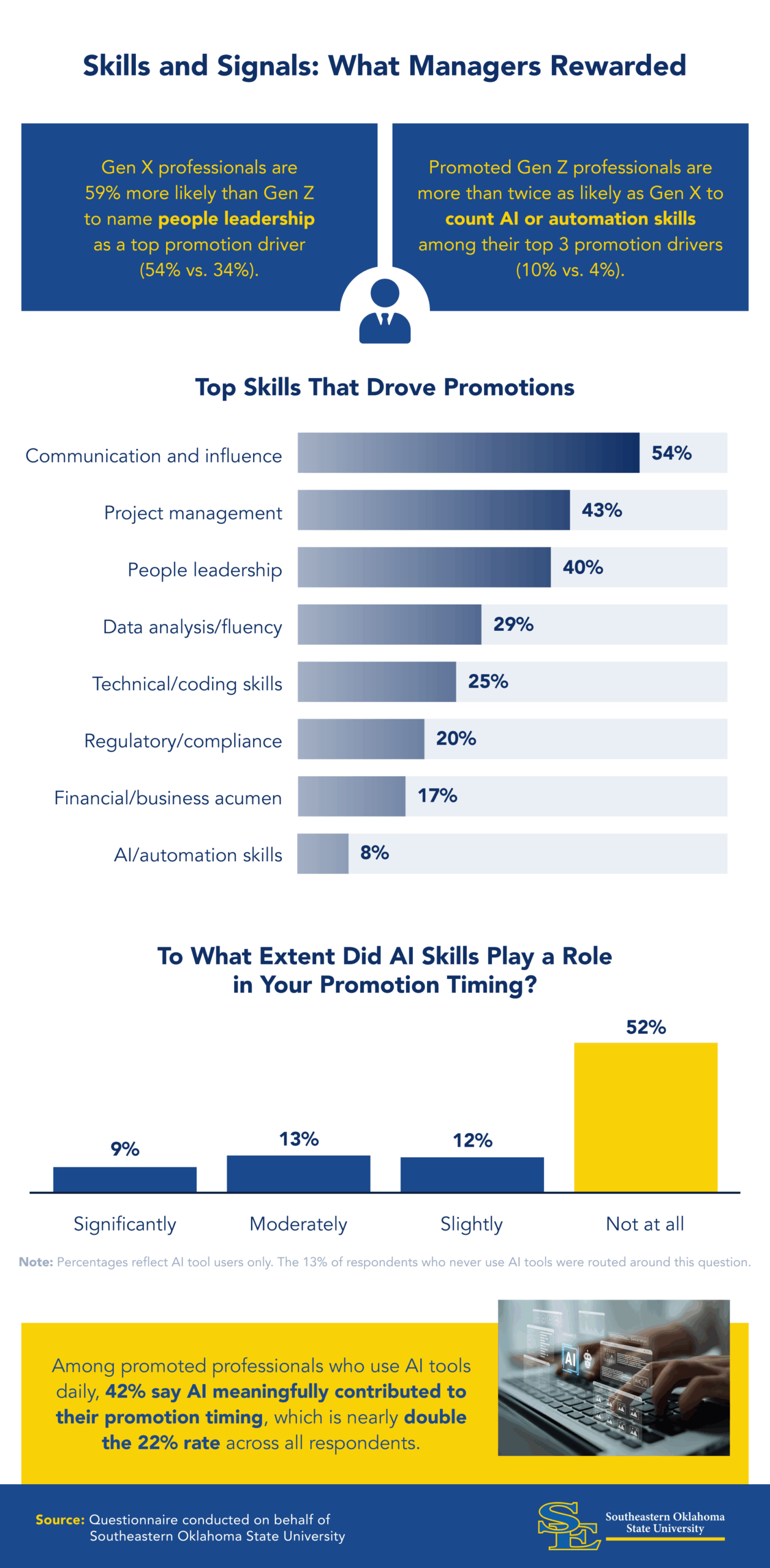
- Communication and influence rank as the top promotion-driving skills, cited by 54% of recently promoted professionals.
- Recently promoted professionals who combined a degree with an industry certification were more likely to say they advanced faster than their peers (60%) than any other credential group.
- Half of credential holders say their educational investment paid for itself in salary gains within 24 months of their promotion, with 28% breaking even in under a year.
- While 87% of recently promoted professionals say they use AI tools at work, 52% say AI played no role in the timing of their promotion.
- Among promoted professionals who credit a credential with helping them advance, 77% say they would choose the same path again, and 60% received at least some financial support from their employer.
- Among credential holders, 38% say time was the biggest barrier to starting sooner, double the share of those who cited cost (19%).
What Credentials Actually Do for Your Career
Credentials don’t guarantee a promotion, but for those who earn one, the payoff often goes well beyond a title change. Certifications and degrees are shaping compensation, career trajectory and the pace of advancement for many professionals.
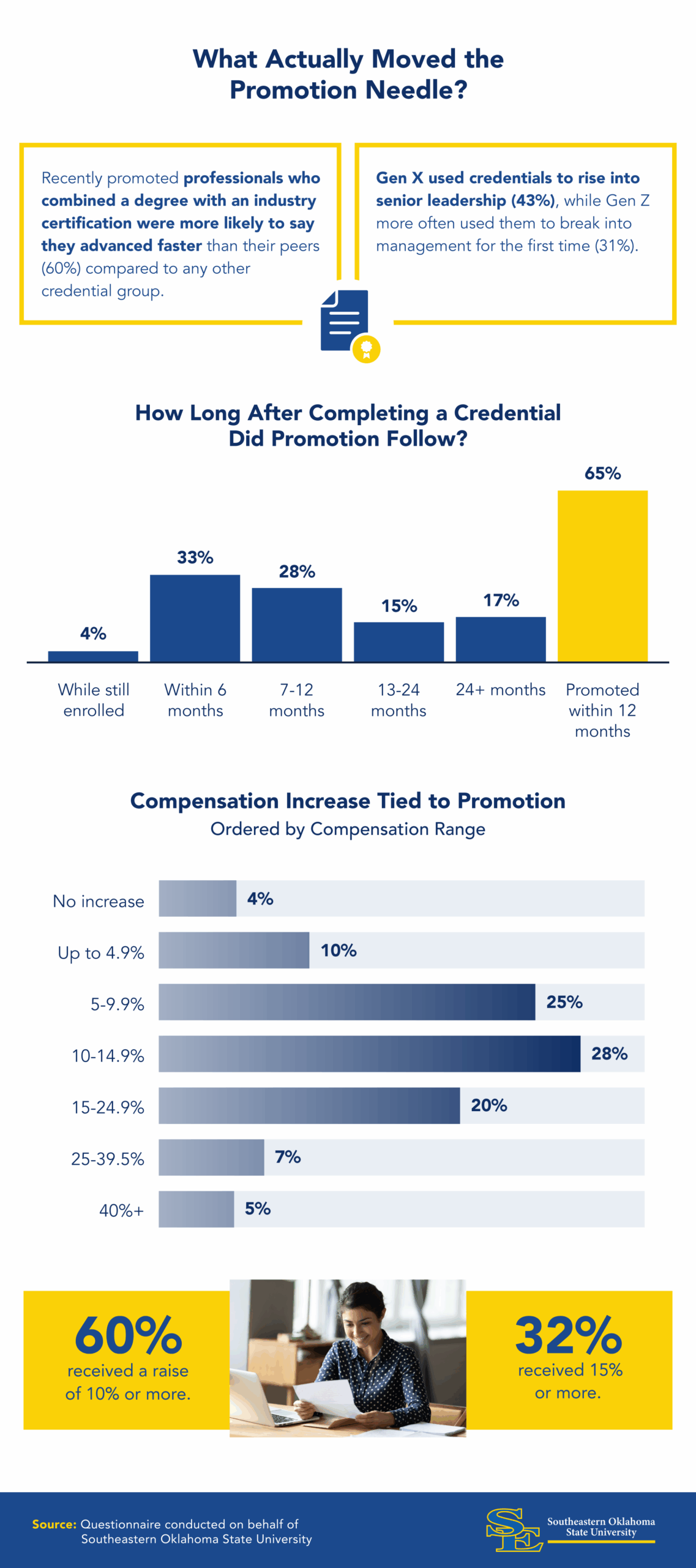
While 73% of recently promoted professionals credit their advancement solely to on-the-job performance, the remaining 27% point to a credential as a contributing factor. Among that credentialed group, 65% were promoted within 12 months of completion. This includes 33% who advanced within six months, 28% who did so in seven to 12 months and 4% who received their promotion while still enrolled.
Compensation outcomes further highlight the value of credentials. Sixty percent of credential holders received a salary increase of at least 10%, with 5% seeing gains of 40% or more. Stacking education also appeared to strengthen results. While a degree alone was the most commonly credited credential at 11%, the combination of a degree and certification at 9% produced stronger advancement outcomes, with 60% of these professionals reporting faster progression than peers.
Overall advancement speed was comparable between credential holders and performance-only professionals (47% vs. 48% faster than peers). This suggests that the advantage of credentials shows up more in compensation and role trajectory than in speed alone. Career pathways also varied:
- 33% of credential-backed promotions moved professionals from manager to senior manager or director roles.
- 30% transitioned from individual contributor to first-time manager.
- 19% experienced lateral moves with expanded responsibilities.
- Gen X credential holders were more likely to advance into senior leadership roles (43%), while Gen Z was more likely to move into their first management positions (31%).
The Skills That Signal Leadership Readiness
Employers continue to prioritize how professionals lead, communicate and apply their knowledge in real-world settings. Technical expertise matters, but the ability to influence others remains central to advancement.
Interpersonal skills were mentioned in 63% of promotion discussions, compared to 19% who said their credentials were explicitly referenced. Women were more likely than men to have interpersonal skills cited in promotion decisions (68% vs. 59%), while men were more likely to have their use of data or automation recognized (31% vs. 24%).
Communication and influence ranked as the most important promotion-driving skills, cited by 54% of professionals. Project management (43%) and people leadership (40%) were other top factors.
Generationally, Gen X professionals were more likely to emphasize people leadership (54%) than Gen Z (34%). AI and automation skills ranked last, mentioned by just 8% of recently promoted professionals. Gen Z professionals were more likely to treat AI as a foundational skill, with 10% ranking it among their top drivers compared to 4% of Gen X.
AI adoption was widespread but uneven in its impact. While 87% of professionals reported using AI tools, 52% said AI played no role in the timing of their promotion. Among daily users, however, 42% said AI contributed meaningfully, suggesting that consistent application matters more than occasional use.
More than one-third of AI users (36%) had at least one AI-related output referenced in their promotion discussion. Automated workflows that saved time or cost were the most cited proof point at 18%. Only 6% had AI certifications mentioned, and just 9% of promoted professionals held formal cloud AI certifications. Among tools, ChatGPT led adoption at 53%, followed by Google Gemini and Microsoft Copilot (37% each), with Anthropic Claude (14%).
The Return on Investment and Future Learning Paths
Professionals are increasingly evaluating education based on both financial return and long-term career flexibility. Many see clear value, but barriers still influence when and how they pursue credentials.
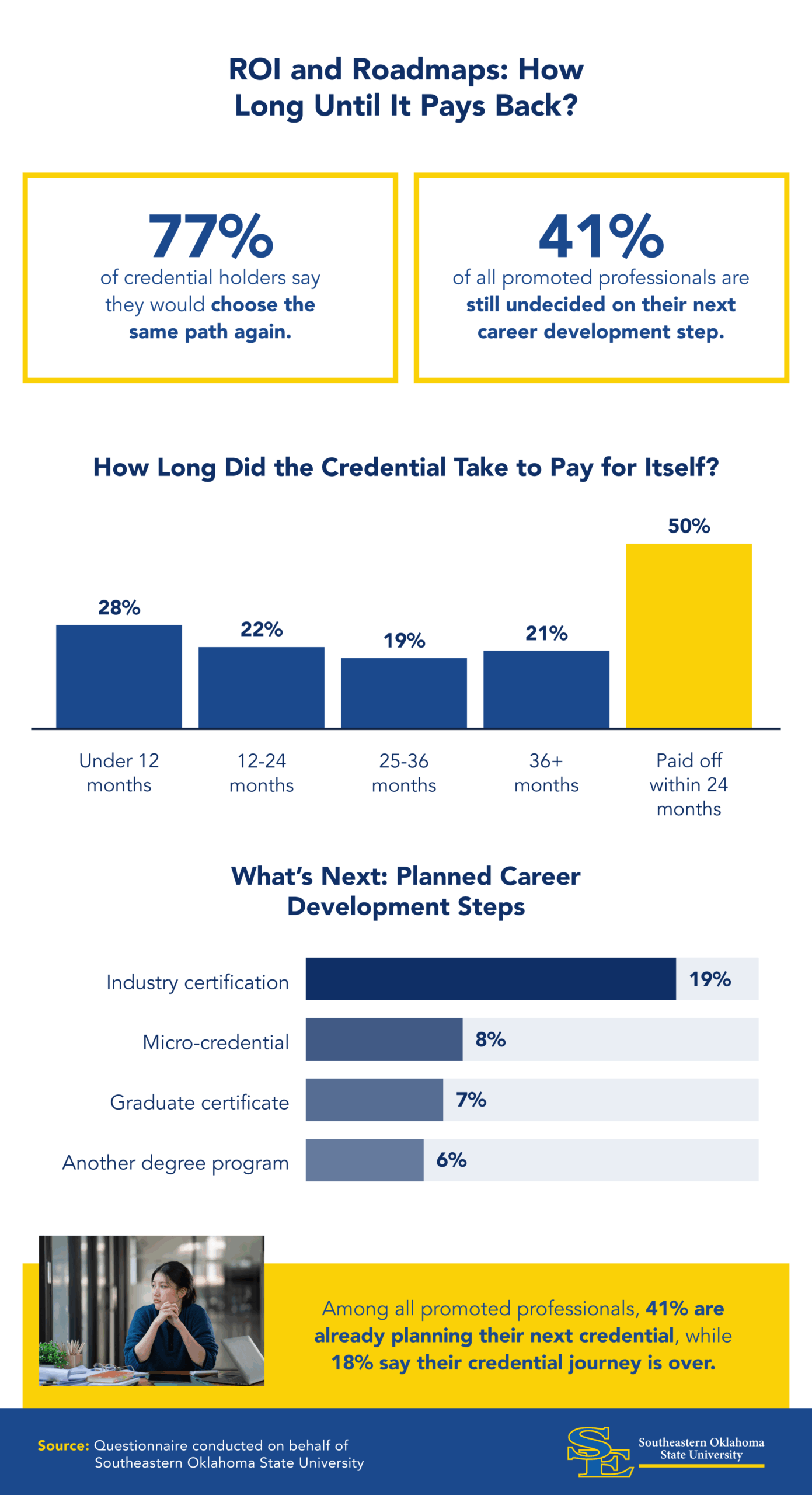
While 60% of credential holders received at least some financial assistance from their employer to pursue their program, others were left to foot some or all of the cost. Half of credential holders reported that their investment paid for itself within 24 months of their promotion, with 28% breaking even in under a year.
Satisfaction levels were high, as 77% said they would choose the same credential path again. Only 8% expressed regrets, with uncertainty about outcomes and time limitations being the most commonly cited barriers. Time was the most significant barrier to starting a credential, cited by 38% of respondents, compared with 19% who cited cost. Men were more than twice as likely as women to cite time limitations (51% vs. 23%), while women were nearly three times more likely to cite caregiving responsibilities (17% vs. 6%).
Credential holders also reported stronger readiness for advancement. Fifty-two percent felt prepared to take on expanded roles within six months of completing their program, compared to 40% of performance-only professionals. This suggests that structured learning may accelerate confidence as well as capability.
Looking ahead, 41% of promoted professionals plan to pursue additional education, with industry certifications leading at 19%. This trend was especially common among those who had already experienced credential-backed promotions, indicating a compounding effect. In contrast, 18% reported no plans for further education, a group largely concentrated among Gen X professionals and those already in senior leadership roles.
Preparing for the Next Step in Your Career
While performance remains a primary driver of advancement, credentials can enhance compensation, clarify career direction and support leadership transitions. Skills such as communication and influence continue to carry the greatest weight, while technical tools like AI matter most when tied to measurable outcomes.
For those considering their next step, flexible online programs offer a way to build both credentials and practical skills without stepping away from full-time work. Many programs offer asynchronous coursework, accelerated tracks and self-paced modules that fit around demanding schedules rather than requiring professionals to fit around them. A thoughtful approach to education can help align experience with opportunity and help you move forward in today’s workplace.
Methodology
This study was conducted online on behalf of Southeastern Oklahoma State University in March 2026 among 602 U.S. adults who met two qualifying criteria: They are currently employed full-time, and they have received a work-related promotion in the past five years, defined as a title change, compensation increase or expanded scope of responsibility. Survey data was collected via CloudResearch Connect. Respondents who failed an internal quality check were excluded from analysis, resulting in a final clean sample of 602 respondents with unique participant IDs.
Respondents who credited a formal credential, including a degree program, a degree paired with an industry certification, a standalone certification, a micro-credential or a bootcamp as the primary driver of their promotion were routed through an extended credential module (Questions 4-10). This credential-holder subsample represents 162 respondents (27% of the total sample). All remaining questions (11-19) were answered by the full sample of 602. Multi-select questions are presented as a percentage of total respondents rather than total selections.
Generational ranges are defined as follows:
- Gen Z (ages 18-29): 16%
- Millennial (ages 30-45): 62%
- Gen X (ages 46-61): 20%
- Baby boomer (ages 62+): 2%
Gender breakdown of respondents is as follows:
- Men: 51%
- Women: 48%
- Non-binary: 1%
All percentages are rounded to the nearest whole number. Demographic subgroups representing fewer than 5% of the total sample are excluded from cross-tab breakdowns.
About Southeastern Oklahoma State University
Southeastern Oklahoma State University offers flexible online programs designed for working professionals seeking career advancement. Southeastern’s AACSB-accredited online Master of Business Administration (MBA) in General Business program prepares students to build leadership, communication and strategic decision-making skills that align with today’s workplace demands. With a focus on practical application and accessibility, Southeastern supports learners at every stage of their career journey.
Fair Use Statement
This content is provided for noncommercial use only. If shared or referenced, please include proper attribution and a link back to Southeastern Oklahoma State University.